Insurance Help from Hagan RP
You receive Angleton insurance experts who measure risk and adapt coverage for properties and enterprises. We evaluate loss history, copyright KPIs, and local hazards to properly structure limits, deductibles, and premiums. Anticipate faster claim resolution, clear timelines, and quarterly audits that validate cost containment. For homeowners, we analyze replacement cost, hazard scores, and deductible scenarios. For businesses, we integrate GL, property, BI, WC, auto, and cyber with A- to A++ carriers. Discover how we convert data into measurable protection.
Main Points
- Local Angleton proficiency merging local market data with sector developments to develop customized, budget-friendly insurance programs.
- Accelerated claim resolution with documented cycle-time metrics and advocacy to lower loss costs and disputes.
- Personalized home insurance policies utilizing replacement-cost modeling, hazard ratings, and deductible scenarios to close coverage gaps.
- Comprehensive business insurance merging liability, property, business interruption, workers' compensation, auto, and cyber via AM Best A- to A++ providers.
- Analytics-based benchmarking and regular quarterly audits to refine limits, deductibles, and overall risk costs.
Why Angleton Chooses Hagan Risk Partners
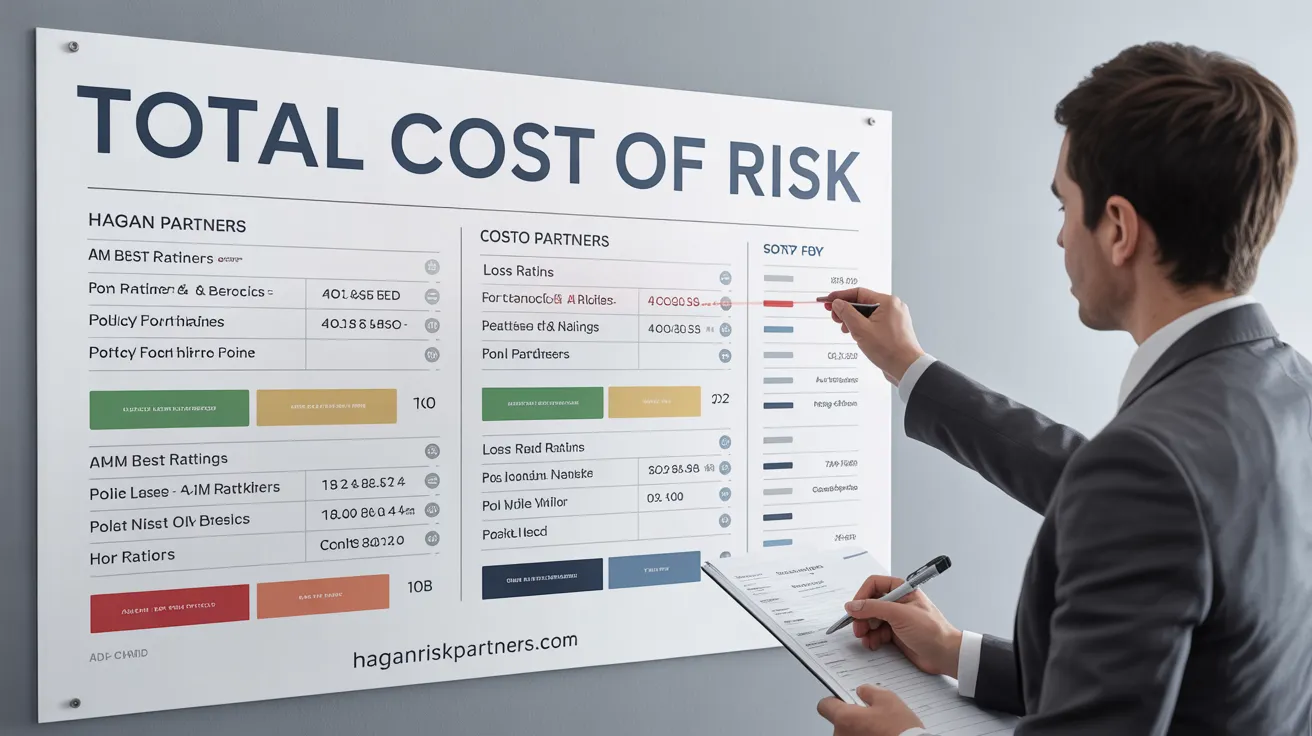
Typically, Angleton businesses select Hagan Risk Partners because the firm produces measurable results: faster claim resolution, targeted coverage design, and documented cost containment. You appreciate that rigor. The team benchmarks your loss history, industry exposures, and regulatory obligations, then identifies high-frequency, high-severity risks. You obtain quantified recommendations tied to KPIs-loss ratio reduction, claim cycle time, and total cost of risk.
You further profit from local intelligence. Through community partnerships, Hagan compiles incident data, vendor performance metrics, and regional hazard trends to calibrate pricing and retention strategies. Their disaster preparedness planning utilizes scenario modeling, supply chain mapping, and critical function recovery timelines, so you can preserve operations. Quarterly audits confirm outcomes, modify limits and deductibles, and reassign spend to controls that show the best ROI.
Customized Insurance for Households and Families
You need coverage that aligns with your home's risk profile, so we analyze personalized home policy options by price, coverage limits, and loss history trends. We also assess gaps that affect families-including personal liability, valuables, and temporary living costs- before we align them with family-focused protection plans. The result is a measurable fit: right-sized deductibles, clear exclusions, and premiums calibrated to your household's actual exposure.
Customized Residence Insurance Options
From property size to roofing condition, tailored home insurance policies are built on the data that drive risk and cost. You benefit when protection limits, hazards, and additional coverages align with your home's profile and your risk tolerance. We assess rebuild costs, evaluate local hazard assessments, and review claims data to guide policy personalization that avoids coverage gaps and overinsurance.
We construct scenario analyses to direct deductible selection: increasing deductibles can decrease premiums between 8 and 20 percent contingent upon loss history and catastrophic risk exposure, while lower deductibles enhance cash flow consistency. You have the ability to adjust separate wind/hail deductibles, water backup limits, and replacement cost provisions based on materials, systems age, and occupancy. We also benchmark copyright forms, sublimits, and exclusions, then suggest options that provide measurable value per premium dollar-objective choices, not guesswork.
Family-Oriented Security Plans
More than just the building itself, insurance should reflect who lives inside it. You need coverage suited to real household risks: age mix, health profiles, valuables, and daily routines. We quantify exposures using local loss data, claims frequency, and replacement-cost models, then construct limits and endorsements to fit.
Begin with liability and dwelling limits sized to replacement costs, not market value. Add scheduled personal property for jewelry, tech, and hobby equipment. Include medical payments and personal injury coverage to cushion guest incidents. For multigenerational planning, coordinate umbrella limits, in-home caregiver endorsements, and living-arrangement riders to account for parents, adult children, or renters. Enhance loss-of-use for temporary housing. Don't forget pet protection— animal liability, boarding reimbursement after a claim, and vet expense riders ensure stable outcomes.
Comprehensive Corporate Insurance Plans
Although exposures vary by sector, a complete business insurance program typically incorporates general liability, commercial property, business interruption, workers' compensation, commercial auto, and cyber liability to eliminate critical exposure gaps. You safeguard assets, minimize third-party claims, and stabilize cash flow when operations are halted. Business interruption supports business continuity by reimbursing lost income and operational expenses after a covered event. General liability covers bodily injury and property damage claims; commercial property covers buildings, equipment, and inventory.
Workers' compensation funds healthcare costs and wage replacement for workplace accidents, decreasing litigation risk. Commercial vehicle coverage includes owned and non-owned vehicles, matching limits with vehicle usage and radius. Cyber liability responds to data breaches, ransomware, and regulatory penalties, covering forensics, notification, and recovery. Combined, these coverages create measurable financial resilience.
Risk Appraisal and Coverage Refinement
You start by identifying key exposures across liability streams, operations, and assets using incident histories, industry benchmarks, and control audits. Following this, you quantify potential losses with probable maximum loss estimates, scenario modeling, and frequency-severity analytics. Using this data, you customize coverage limits and sublimits to correspond to risk tolerance, cash flow capacity, and regulatory requirements.
Pinpointing Key Exposures
Begin by charting your operations, assets, and liabilities to identify where loss frequency and severity accumulate. Leverage process flowcharts and asset registers to record exposures by location, function, and dependency. Authenticate property valuation via recent appraisals, replacement-cost indices, and contractor bids to eliminate underinsurance or excess limits. Classify critical equipment by failure rates and downtime impact. Examine vendor reliance and single points of failure in supply chains.
Assess cyber exposure by inventorying data types, access rights, and system interconnections; review MFA deployment, patch frequency, and backup integrity. Assess fleet telematics, driver histories, and route density for collision and cargo risks. Review contracts for indemnity gaps and uninsured obligations. Cross-reference incident logs and near-miss data with controls in place, then categorize exposures with weak mitigations and high operational priority.
Evaluating Prospective Losses
Because choices rely on numbers, convert identified exposures into credible loss estimates using frequency-severity modeling and scenario analysis. Begin with exposure assessment: here quantify asset values, process volumes, headcount, and critical dependencies. Utilize historical losses, industry benchmarks, and local Angleton hazard data to adjust frequency. For severity, model replacement/repair costs, downtime, liability trends, and inflationary pressures.
Utilize loss modeling approaches: fit appropriate distributions, stress-test parameter uncertainty, and execute Monte Carlo simulations to produce expected loss, percentile outcomes, and tail value at risk. Segment by peril and location to capture correlation and accumulation. Validate results with back-testing and sensitivity analysis to isolate the drivers that materially shift outcomes. Show outputs as loss ranges with confidence intervals and clear assumptions so you can prioritize controls and allocate risk capital effectively.
Customizing Coverage Limits
Whereas loss modeling quantifies the risk, tailoring coverage limits transforms those insights into precise dollar thresholds that cap retained volatility without overpaying for insurance. You translate loss exceedance curves into policy limits that correspond to your risk tolerance and liquidity. Initiate by mapping your 1-in-10, 1-in-25, and 1-in-50 year losses, then set limits to transfer tail risk beyond your balance-sheet capacity. Fine-tune deductible selection using cash flow at risk, working capital cushions, and historical loss frequency.
Then, perform scenario stress-testing: modify limits and deductibles to fulfill target probability-of-ruin and budget constraints. Evaluate marginal cost per dollar of limit to eliminate inefficient layers. Verify decisions with sensitivity analysis across rate structures, inflation, and vendor concentration. Document limit rationale and trigger points for mid-term modifications.
Claims Advocacy and Responsive Support
Navigate post-incident confusion with dedicated claims advocacy that prioritizes speed, accuracy, and measurable outcomes. You get a swift response within defined service-level targets, plus clear timelines for documentation, copyright contact, and resolution milestones. We track cycle times, record adjuster touchpoints, and quantify recovery ratios so you see where delays occur and how we address them.
We coordinate claims mediation to decrease disputes, tighten negotiation periods, and elevate settlement quality. You receive well-defined checklists for evidence documentation, loss calculation, and subrogation possibilities, which assists in restrict leakage and hastens payment. We examine root causes across your loss history to pinpoint process gaps and strengthen controls. You keep current with succinct updates, escalation thresholds, and post-close debriefs that feed continuous improvement and enhance future claim outcomes.
Professional Knowledge and Area Market Understanding
The same verifiable claims data originate from sector-focused expertise and hands-on understanding in Angleton. You benefit when we merge Regional knowledge with data on Industry trends, loss drivers, and regulatory shifts affecting Brazoria County. We evaluate incident-severity data by class code, benchmark your loss ratios, and map exposures to local factors like hurricane wind zones, petrochemical supply chains, and commuter traffic corridors.
We measure risk using historical weather data, OSHA incident rates, and building valuations, then turn those findings into coverage limits, deductibles, and risk controls. You see transparent reasoning: why property schedules need wind mitigation credits, why fleet telematics minimizes collision severity, and where cyber controls reduce vendor-led breaches. This analytical approach synchronizes your insurance structure with Angleton's real operating environment.
Cost-Effective Options Provided By Leading Insurance Carriers
Since copyright selection influences both cost and claim outcomes, we market your program to a curated panel of A- to A++ AM Best-rated insurers with established loss performance in Brazoria County. We evaluate rate filings, loss ratios, and form language to quantify total cost of risk, not just premium.
You get Insurance copyright evaluations that highlight rate drivers: business class codes, limits, deductibles, territory, and experience modification factors. We compare quotes against credible exposure data and flag outliers using variance thresholds. We also evaluate claims management KPIs— processing time, litigation rates, reserve accuracy, to forecast net expense.
Discount opportunities are strategically identified, not presumed. We leverage policy scheduling credits, multi-policy bundling, loss prevention commitments, telematics, and greater deductibles where returns justify the approach. The end result: data-driven competitive alternatives, with clear cost-benefit considerations and quantifiable cost reductions.
Getting Started With Your Tailored Policy
Start by mapping your exposures and priorities, then feed us the data points that drive pricing and coverage design: operations, payrolls, revenues, fleet VINs, driver MVRs, location COPE details, prior losses (five-year BOR/LLR), and desired limits/deductibles. We will convert that dataset into a quantified risk profile, identifying severity and frequency drivers.
Next, complete a structured needs assessment with our local agents. We will benchmark your metrics against industry peers, loss triangles, and rating factors. From there, we will model alternative deductibles, coverage forms, and retentions to optimize your overall risk costs.
We'll examine draft terms, exclusions, and endorsements side-by-side. We'll verify copyright appetite, financial strength, and claims protocols. Approve the bind order, define audit calendars, and set reporting cadence. After binding, we oversee KPIs and modify at renewal.
Questions & Answers
What Are Your Office Hours and Holiday Closures in Angleton?
Our Angleton office hours operate Monday-Friday, 8:30 a.m.-5:00 p.m., with last appointments at 4:30 p.m. We close for lunch from 12:00-1:00 p.m. Saturday service are available by appointment; Sundays are closed. Holiday closures follow federal observances: New Year's Day, Memorial Day, Juneteenth, Independence Day, Labor Day, Thanksgiving (Thu-Fri), and Christmas (Dec 24-25). You can confirm real-time changes to office hours and holiday closures on our website or by calling ahead.
Do You Have Bilingual Team Members for Spanish-Speaking Clients?
Absolutely-you'll receive bilingual agents and comprehensive Spanish support. Rapid solutions, not assumptions; accurate translations, not misunderstanding. We pair you with licensed agents fluent in English and Spanish, minimizing errors and shortening call times. Data shows bilingual servicing cuts follow-up calls by 20-30% and boosts policy comprehension scores. You'll receive rate estimates, claims assistance, and policy reviews in Spanish or English, via phone, electronic message, or in-person. Choose Español? Tell us, and we'll emphasize Spanish-first communication.
How Do You Protect My Personal Data and Documents?
We safeguard your personal data and documents with multi-layered security measures. We use Data protection encryption in transit (TLS version 1.2+) and at rest (AES-256 encryption), apply MFA protocols, minimal access privileges, and permission controls based on roles. We maintain Secure backups with immutable storage and regular restore tests. We track our systems around the clock, apply updates quickly, and record all access for security audits. We vet vendors, use SOC 2-compliant policies, and deliver security training for employees and anti-phishing training to reduce human risk.
Can I Access Virtual Consultations and E-Signatures?
Indeed-virtual consultations and e-signatures are available. You arrange Virtual appointments through a secure portal; typical setup time is less than 2 minutes, with 99.9% uptime. You complete Digital signatures using AES-256 encryption and audit trails, cutting turnaround by 60-80% against in-person meetings. While phone calls appear familiar, real-time video combined with ID verification increases accuracy and decreases errors by 30%. You receive copies instantly, and multi-factor authentication secures every step.
What Payment Options and Billing Plans Are Available?
Payment is accepted by credit card, debit card, bank transfer, or ACH. You'll choose billing plans like monthly, quarterly, semiannual, or annual, based on policy type and risk profile. Auto‑pay and paperless billing reduce missed payments and processing time. You may divide premiums via financed payment plans pending credit approval. We'll supply due dates, proration details for mid‑term changes, and itemized invoices, so you can reconcile expenses accurately and maintain uninterrupted coverage.
Wrapping Up
As the navigator, Hagan Risk Partners acts as your trusted compass. In a market sea defined by loss ratios, coverage limits, and copyright AM Best ratings, you guide your course using solid data, not assumptions. Their risk assessments, claim advocacy metrics, and optimization models act as your navigation points, aligning deductibles and premiums to your map. With local insight and highly-rated carriers, you don't drift-you plot. Start your customized policy immediately, and turn uncertainty into a course you can measure, verify, and rely on.